Fiscal deficit, the gap between government's expenditure and revenue, stood at 4.5 per cent in FY14, lower than 4.9 per cent in FY13.

As it stands, there does not seem to be a threat to prices.

Liquidity issues post the crisis at DHFL, progress of monsoon, rupee trajectory at the domestic level and oil prices are some factors that will keep markets choppy, analysts say.

IMD has said the temperature in April-June across most parts in India is expected to be 0.5-1 degrees Celsius warmer than normal. However, doctors and scientists say they haven't found any direct correlation between the speed of COVID-19 spread and warm weather.

In Gujarat, of the 12.5 million hectare of area under cultivation, while six million is dependent on rainfall, two million is covered by groundwater, a bulk of which is said to be in north Gujarat. Scanty rainfall in the last one and half years has not only depleted groundwater level but also affected dams.

Forecast of normal monsoon and a good harvest will boost the purchasing power of gold among farmers in India, said a report from the leading Asian investment bank, HSBC.

The disaster management department said that the state government has urged the Indian Air Force to send a helicopter for air-dropping of food packets and other relief material in marooned areas.

State behemoth Coal India, the world's largest coal miner, has failed to raise its output fast enough to meet demand, and millions of Indians still go without power.

Incessant rains over the past two days in eastern Rajasthan have led to a flood-like situation in the region and severed road connectivity to many areas.
RBI has retained the GDP forecast at 8.5 per cent for 2007-08; inflation kept close to 5 per cent this year.
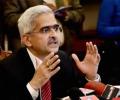
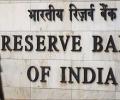
Reserve Bank Governor Shaktikanta Das has pitched for policy support from all sides -- fiscal, monetary and sectoral -- to nurture recovery of the economy hit by the second wave of the coronavirus pandemic. The dent on economic activity due to the second wave of the pandemic during April-May necessitated continuation of monetary measures to support the process of economic recovery to make it durable, Das had said while participating in the meeting of the Monetary Policy Committee (MPC) earlier in the month. "Overall, the second wave of COVID-19 has altered the near-term outlook, and policy support from all sides - fiscal, monetary and sectoral - is required to nurture recovery and expedite return to normalcy," Das said, as per the minutes of the meeting released on Friday.

Subdued exports remain an area of concern.

The global financial services major had earlier said that the central bank would keep its policy rates on hold.

Progress on monsoons along with favourable base effect in 2HFY2017 continues to point towards RBI achieving its near 5 per cent inflation target by the year-end

The government hopes of registering GDP growth rate ranging between 6.1-6.7 per cent in 2013-14.
Food packets have been distributed to 5,000 persons affected by rains.

Analysts say markets to be impacted by monsoon, inflation trajectory.

Rejecting IMF and World Bank's "unduly" pessimistic projections, Prime Minister's key economic advisory council chairman C Rangarajan on Thursday exuded confidence that the growth would be around 5.5 per cent in the current fiscal.
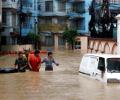
Nepal has been hit by heavy rainfall since Thursday. More than 25 districts and 10,385 households have been affected.

The Express Tribune reported that a post-flood report of the Irrigation and Power Department says India provided misleading information regarding water flows in Rivers Chenab and Jhelum resulted in aggravating damage in 14 districts during floods between September 5 and 17.

The snowfall has prompted authorities to shut down the Jammu-Srinagar National Highway and schools and colleges are also shut.

The agency welcomed the Rs 1.70-lakh crore package announced by Finance Minister Nirmala Sitharaman earlier in the day but said more measures like loan forbearances for small businesses and households are necessary.

India Ratings on Mondy projected a 7.7 per cent growth this fiscal driven by consumption demand.

At least 33 people have been killed in flash floods in Bihar till Tuesday evening and 25.71 lakh people are affected in 16 districts of the state.
Projecting a higher growth rate of 8.3 per cent, the Confederation of Indian Industry on Thursday tempered the optimism with the caution that hardening interest rates, below-normal monsoon and spiralling oil prices could cut-off the crescendo.
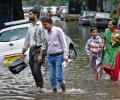
Officials however warned of a 4.81 metre high tide in afternoon coupled with heavy showers, which may cause flash floods in low-lying areas in the city.

the India Meteorological Department has forecast intermittent rain with heavy to very heavy showers in the city and suburbs and extremely heavy rain at isolated places in next 24 hours.

The Met department forecast heavy to very heavy showers in north coastal Tamil Nadu till Saturday.

India's economy grew an historically modest 7 per cent last quarter but industrial output has generally been strong.

The Finance Ministry's Economic Survey had projected a growth rate of 7-7.75 per cent.

RBI has brought down forecasts of both year-end inflation and growth.
Rainfall recorded in the last 24 hours till 8.30 am on Wednesday was 32.8 mm in Colaba in south Mumbai and 16.6 mm in Santacruz, it added.

Bank of Baroda ended flat after sharp gains in the previous session.

Two-thirds of gold demand in India comes from rural areas where jewellery is a traditional store of wealth.
With all-round upturn in economic cycle except in agriculture, Economic think tank NCAER has forecast India's GDP growth rate at 6.5 to 6.7 per cent for this fiscal.

Pressure has been mounting on the Reserve Bank of India to cut interest rates in the wake of declining retail inflation and the need to fuel growth momentum. However, the RBI will have to do a tightrope walk as globally interest rates are inching upwards.

Asian Paints was the top gainer after the paints major posted robust first quarter earnings.
With improved prospects for the farm sector, Centre for Monitoring Indian Economy on Friday raised the economic growth forecast for 2005-06 to 6.8 per cent from the earlier six per cent.
One of the major contributors for the decline in growth will be the monsoon deficiency, which also affects non- agricultural sectors through demand effects, RBI report said.
